
Stay informed with free updates
Simply sign up to the Airlines myFT Digest — delivered directly to your inbox.
Airlines have averted the threat of major global travel disruption after rushing to fix a software glitch on Airbus A320 jets caused by intense solar radiation.
Carriers worked through Friday night and into the weekend after aviation regulators said they must fix the problem before resuming flights.
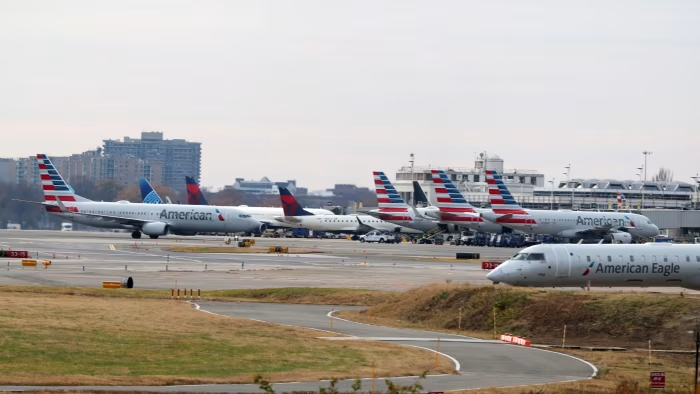
American Airlines, Delta Air Lines and Air India were among those that said they had completed software updates by Saturday, along with European low-cost operators Wizz Air and EasyJet.
Data from flight tracker FlightAware showed most big airports reporting good traffic flow, although some had minor problems.
In the US, where the glitch threatened to disrupt the busy Thanksgiving travel weekend, transportation secretary Sean Duffy said in a social media post on Saturday that carriers had “reported great progress” and were “on track to meet the deadline of this Sunday at midnight to complete the work”.
Some airlines, however, were harder hit. Colombia’s Avianca said on Friday that more than 70 per cent of its fleet was affected and that it was halting ticket sales until December 8.
In Asia, Japan’s ANA said on Sunday that it had completed the software updates on all the affected aircraft but that the work had resulted in a “significant number” of domestic flight delays and cancellations over the weekend. The carrier cancelled 95 flights on Saturday, affecting about 13,200 passengers.
Guillaume Faury, chief executive of Airbus, apologised to airline customers and passengers for the “significant logistical challenges and delays”. The manufacturer’s teams were “working round the clock” to enable carriers to “get planes back in the sky”, Faury wrote in a social media post on Saturday.
Airbus on Friday had warned that a “significant” number of its A320 family of aircraft, the world’s most widely flown commercial jet, needed an immediate software update after finding that intense solar flare radiation could corrupt data critical to the functioning of flight controls.
About 6,000 aircraft, half of the global fleet in service, were affected. Most of the jets have been able to undergo an uncomplicated software fix by reverting to a previous version — a process that takes about two to three hours. But about 900 aircraft require a change in hardware, which will take longer.
Airbus discovered the issue after a JetBlue Airways flight between the US and Mexico suffered a control problem and a sudden drop in altitude, which forced an emergency landing in Tampa, Florida.
The investigation traced the problem to a flight system that sends commands from the pilot’s sidestick to elevators at the rear of the plane. Those elevators control the aircraft’s pitch or nose angle.